 by
by Your Home page is working right now – or it isn’t.
Every day, potential clients land on your website, look around for a few seconds, and make a decision. Stay or leave. Enquire or move on. Trust you or click back to Google and try someone else.
The difference between those outcomes? Almost always comes down to your words.
Why most Home pages underperform
Most service business websites have a Home page that was written in a hurry, copied loosely from a competitor, or put together by a web designer whose strength is aesthetics rather than strategy. The result looks professional enough – but it doesn’t sell.
Here’s what’s usually missing:
- A clear, benefit-led headline that speaks directly to the ideal client.
- A problem and solution block that makes visitors feel understood before you start selling.
- Trust signals that build credibility in seconds.
- A services overview that uses the exact words clients search for.
- And calls to action that are specific, warm, and genuinely persuasive.
When all of these elements are working together, your Home page stops being a brochure and starts being your best salesperson – available 24 hours a day, seven days a week, never asking for a raise.
The 3 audiences your Home page must serve
Here’s something most DIY website copy misses entirely: your Home page doesn’t just need to impress human visitors. It needs to work for three distinct audiences simultaneously.
- Your ideal clients: Who need to feel seen, understood, and confident that you’re the right choice for them.
- Search engines: Which read your page to decide whether to surface your business when someone searches for what you do.
- AI tools: Like ChatGPT, Perplexity, and Google’s AI Overviews, which are increasingly being used to find and recommend service businesses. If your content isn’t structured in a way these tools can interpret clearly, you’re invisible to a growing segment of potential clients.
Writing for all three at once is a skill – but it’s absolutely learnable.
The 11 sections every high-performing Home page needs
A well-structured Home page isn’t random. There’s a proven sequence that takes a visitor from first impression to confident enquiry – and it has 11 distinct sections, each with a specific job to do.
Those sections include your navigation bar, hero section, trust bar, problem and solution block, services overview, how it works strip, testimonials, about snapshot, blog preview, final call to action, and footer.
Each one matters. Each one has a right and a wrong way to approach it. And getting all 11 working together is what separates a Home page that converts from one that simply exists.
Where to start: creating a Home page that converts
If you’re looking at your Home page and wondering where to begin, start with your headline. It’s the single highest-impact element on the page – and it’s often the weakest.
Ask yourself: does my headline tell a first-time visitor, in plain English, exactly who I help and what I do for them? Does it lead with a benefit rather than a clever phrase? Does it contain the words my ideal clients actually search for?
If the answer to any of those is no – or “I’m not sure” – that’s your starting point.
Want the complete framework?
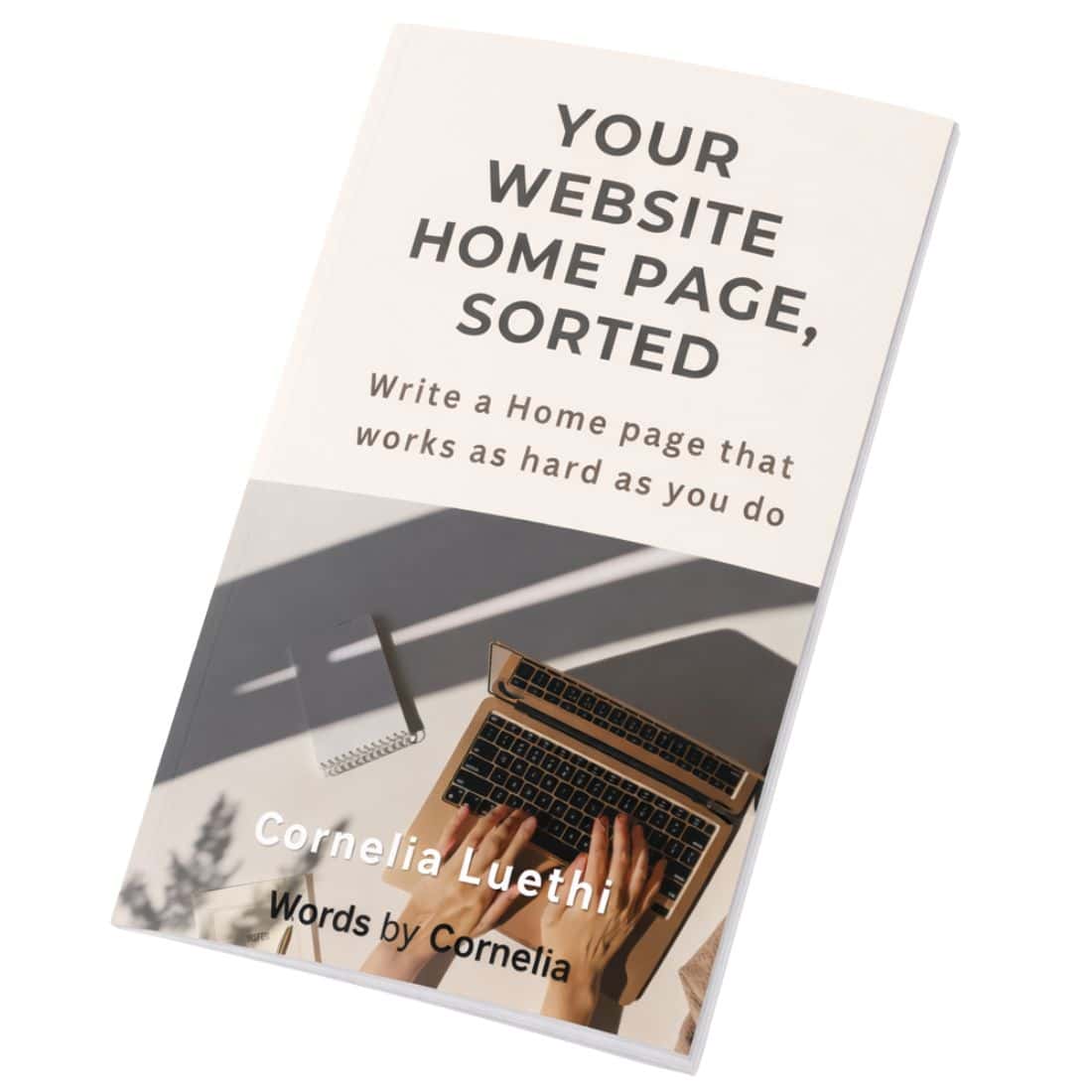
If you’d like a step-by-step guide to writing every section of your Home page – with copywriting tips, SEO and AI notes, and real examples – I’ve put everything into a practical PDF guide.
‘Your Website Home Page, Sorted‘ walks you through all 11 sections of a high-performing Home page, written from 30 years of marketing experience. It’s designed for service business owners who want to write their own copy – with expert guidance behind every decision.
Find out more about the ‘Your Home Page, Sorted’ guide


Cornelia Luethi: content writer and marketing strategist with 30 years of expertise.
Cornelia Luethi is a content writer and marketing strategist based in Kerikeri, New Zealand, working with service businesses across New Zealand, Australia, the UK, and the United States. A client once called her “the Swiss watch of marketing” – she’s taken that as her standard ever since.